 Add to Chrome
 Add to Firefox
 Add to Edge
RICE-PO: Turning Retrieval Interactions into Credit Signals for Reasoning Agents
May 25, 2026
Retrieval is increasingly moving from one-shot matching toward interactive reasoning, where language agents iteratively inspect evidence, reformulate queries, and search again. Training such agents raises a credit-assignment challenge: executable actions such as queries or summaries can be directly evaluated by the retriever, while latent reasoning steps are not directly observable and only affect future executable actions. This asymmetry makes outcome-level reward assignment unreliable, as the same final reward may credit reasoning steps that did not actually shape retrieval success. We propose RICE-PO, a critic-free policy optimization framework that converts retrieval interactions into localized learning signals. RICE-PO selects high-uncertainty executable actions as anchors, evaluates local counterfactual branches using retrieval metrics, and propagates credit to latent reasoning steps only when reasoning-to-action influence is strong and future residual effects are stable. On BRIGHT and BEIR, RICE-PO consistently outperforms prompt-based agents and group-based RL baselines under the same retriever setting. These results show that the structure of agent-environment interaction itself can provide useful supervision for training reasoning-based retrieval agents.

LLM Agents Enable User-Governed Personalization Beyond Platform Boundaries
May 10, 2026Personalization today is fundamentally platform-centric: services build user representations from the behavioral fragments they observe. Yet no platform can construct a complete picture of the user, as competitive incentives, legal constraints, user privacy concerns, and epistemic limits create persistent data barriers. This paper argues for a shift from platform-centric personalization to user-governed personalization, where only the user can integrate fragmented contexts across platforms and the offline world. The key asymmetry lies in data access: only users can aggregate their own cross-platform and offline information. Large language model (LLM) agents make such integration practically feasible for the first time by enabling reasoning over heterogeneous personal data and transforming users' cross-context information into actionable personalization capabilities. We provide proof-of-concept evidence that users equipped with cross-platform data exports and an off-the-shelf LLM agent can outperform single-platform personalization baselines. We conclude by outlining a research agenda for building scalable user-governed personalization systems.
CoSearch: Joint Training of Reasoning and Document Ranking via Reinforcement Learning for Agentic Search
Apr 21, 2026Agentic search -- the task of training agents that iteratively reason, issue queries, and synthesize retrieved information to answer complex questions -- has achieved remarkable progress through reinforcement learning (RL). However, existing approaches such as Search-R1, treat the retrieval system as a fixed tool, optimizing only the reasoning agent while the retrieval component remains unchanged. A preliminary experiment reveals that the gap between an oracle and a fixed retrieval system reaches up to +26.8% relative F1 improvement across seven QA benchmarks, suggesting that the retrieval system is a key bottleneck in scaling agentic search performance. Motivated by this finding, we propose CoSearch, a framework that jointly trains a multi-step reasoning agent and a generative document ranking model via Group Relative Policy Optimization (GRPO). To enable effective GRPO training for the ranker -- whose inputs vary across reasoning trajectories -- we introduce a semantic grouping strategy that clusters sub-queries by token-level similarity, forming valid optimization groups without additional rollouts. We further design a composite reward combining ranking quality signals with trajectory-level outcome feedback, providing the ranker with both immediate and long-term learning signals. Experiments on seven single-hop and multi-hop QA benchmarks demonstrate consistent improvements over strong baselines, with ablation studies validating each design choice. Our results show that joint training of the reasoning agent and retrieval system is both feasible and strongly performant, pointing to a key ingredient for future search agents.
SynPlanResearch-R1: Encouraging Tool Exploration for Deep Research with Synthetic Plans
Mar 09, 2026Research Agents enable models to gather information from the web using tools to answer user queries, requiring them to dynamically interleave internal reasoning with tool use. While such capabilities can in principle be learned via reinforcement learning with verifiable rewards (RLVR), we observe that agents often exhibit poor exploration behaviors, including premature termination and biased tool usage. As a result, RLVR alone yields limited improvements. We propose SynPlanResearch-R1, a framework that synthesizes tool-use trajectories that encourage deeper exploration to shape exploration during cold-start supervised fine-tuning, providing a strong initialization for subsequent RL. Across seven multi-hop and open-web benchmarks, \framework improves performance by up to 6.0% on Qwen3-8B and 5.8% on Qwen3-4B backbones respectively compared to SOTA baselines. Further analyses of tool-use patterns and training dynamics compared to baselines shed light on the factors underlying these gains. Our code is publicly available at https://github.com/HansiZeng/syn-plan-research.
TARSE: Test-Time Adaptation via Retrieval of Skills and Experience for Reasoning Agents
Mar 01, 2026Complex clinical decision making often fails not because a model lacks facts, but because it cannot reliably select and apply the right procedural knowledge and the right prior example at the right reasoning step. We frame clinical question answering as an agent problem with two explicit, retrievable resources: skills, reusable clinical procedures such as guidelines, protocols, and pharmacologic mechanisms; and experience, verified reasoning trajectories from previously solved cases (e.g., chain-of-thought solutions and their step-level decompositions). At test time, the agent retrieves both relevant skills and experiences from curated libraries and performs lightweight test-time adaptation to align the language model's intermediate reasoning with clinically valid logic. Concretely, we build (i) a skills library from guideline-style documents organized as executable decision rules, (ii) an experience library of exemplar clinical reasoning chains indexed by step-level transitions, and (iii) a step-aware retriever that selects the most useful skill and experience items for the current case. We then adapt the model on the retrieved items to reduce instance-step misalignment and to prevent reasoning from drifting toward unsupported shortcuts. Experiments on medical question-answering benchmarks show consistent gains over strong medical RAG baselines and prompting-only reasoning methods. Our results suggest that explicitly separating and retrieving clinical skills and experience, and then aligning the model at test time, is a practical approach to more reliable medical agents.
Agentic Conversational Search with Contextualized Reasoning via Reinforcement Learning
Jan 19, 2026Large Language Models (LLMs) have become a popular interface for human-AI interaction, supporting information seeking and task assistance through natural, multi-turn dialogue. To respond to users within multi-turn dialogues, the context-dependent user intent evolves across interactions, requiring contextual interpretation, query reformulation, and dynamic coordination between retrieval and generation. Existing studies usually follow static rewrite, retrieve, and generate pipelines, which optimize different procedures separately and overlook the mixed-initiative action optimization simultaneously. Although the recent developments in deep search agents demonstrate the effectiveness in jointly optimizing retrieval and generation via reasoning, these approaches focus on single-turn scenarios, which might lack the ability to handle multi-turn interactions. We introduce a conversational agent that interleaves search and reasoning across turns, enabling exploratory and adaptive behaviors learned through reinforcement learning (RL) training with tailored rewards towards evolving user goals. The experimental results across four widely used conversational benchmarks demonstrate the effectiveness of our methods by surpassing several existing strong baselines.
Can Pre-training Indicators Reliably Predict Fine-tuning Outcomes of LLMs?
Apr 16, 2025While metrics available during pre-training, such as perplexity, correlate well with model performance at scaling-laws studies, their predictive capacities at a fixed model size remain unclear, hindering effective model selection and development. To address this gap, we formulate the task of selecting pre-training checkpoints to maximize downstream fine-tuning performance as a pairwise classification problem: predicting which of two LLMs, differing in their pre-training, will perform better after supervised fine-tuning (SFT). We construct a dataset using 50 1B parameter LLM variants with systematically varied pre-training configurations, e.g., objectives or data, and evaluate them on diverse downstream tasks after SFT. We first conduct a study and demonstrate that the conventional perplexity is a misleading indicator. As such, we introduce novel unsupervised and supervised proxy metrics derived from pre-training that successfully reduce the relative performance prediction error rate by over 50%. Despite the inherent complexity of this task, we demonstrate the practical utility of our proposed proxies in specific scenarios, paving the way for more efficient design of pre-training schemes optimized for various downstream tasks.
Search-R1: Training LLMs to Reason and Leverage Search Engines with Reinforcement Learning
Mar 12, 2025Efficiently acquiring external knowledge and up-to-date information is essential for effective reasoning and text generation in large language models (LLMs). Retrieval augmentation and tool-use training approaches where a search engine is treated as a tool lack complex multi-turn retrieval flexibility or require large-scale supervised data. Prompting advanced LLMs with reasoning capabilities during inference to use search engines is not optimal, since the LLM does not learn how to optimally interact with the search engine. This paper introduces Search-R1, an extension of the DeepSeek-R1 model where the LLM learns -- solely through reinforcement learning (RL) -- to autonomously generate (multiple) search queries during step-by-step reasoning with real-time retrieval. Search-R1 optimizes LLM rollouts with multi-turn search interactions, leveraging retrieved token masking for stable RL training and a simple outcome-based reward function. Experiments on seven question-answering datasets show that Search-R1 improves performance by 26% (Qwen2.5-7B), 21% (Qwen2.5-3B), and 10% (LLaMA3.2-3B) over SOTA baselines. This paper further provides empirical insights into RL optimization methods, LLM choices, and response length dynamics in retrieval-augmented reasoning. The code and model checkpoints are available at https://github.com/PeterGriffinJin/Search-R1.
ATEB: Evaluating and Improving Advanced NLP Tasks for Text Embedding Models
Feb 24, 2025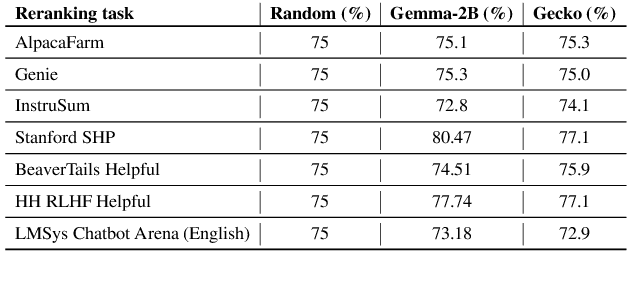
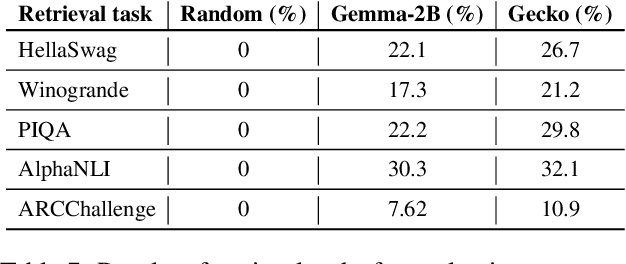
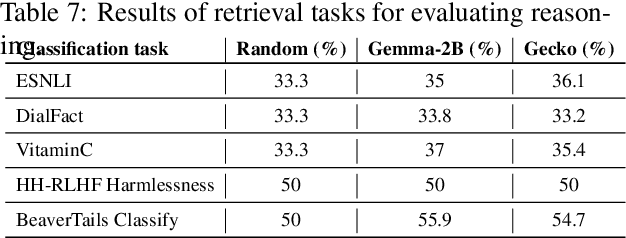
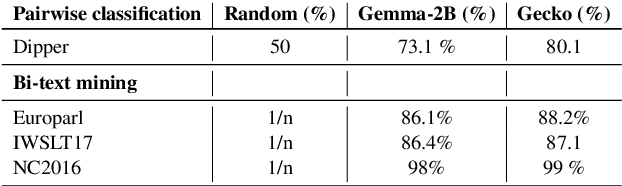
Traditional text embedding benchmarks primarily evaluate embedding models' capabilities to capture semantic similarity. However, more advanced NLP tasks require a deeper understanding of text, such as safety and factuality. These tasks demand an ability to comprehend and process complex information, often involving the handling of sensitive content, or the verification of factual statements against reliable sources. We introduce a new benchmark designed to assess and highlight the limitations of embedding models trained on existing information retrieval data mixtures on advanced capabilities, which include factuality, safety, instruction following, reasoning and document-level understanding. This benchmark includes a diverse set of tasks that simulate real-world scenarios where these capabilities are critical and leads to identification of the gaps of the currently advanced embedding models. Furthermore, we propose a novel method that reformulates these various tasks as retrieval tasks. By framing tasks like safety or factuality classification as retrieval problems, we leverage the strengths of retrieval models in capturing semantic relationships while also pushing them to develop a deeper understanding of context and content. Using this approach with single-task fine-tuning, we achieved performance gains of 8\% on factuality classification and 13\% on safety classification. Our code and data will be publicly available.
Scaling Sparse and Dense Retrieval in Decoder-Only LLMs
Feb 21, 2025Scaling large language models (LLMs) has shown great potential for improving retrieval model performance; however, previous studies have mainly focused on dense retrieval trained with contrastive loss (CL), neglecting the scaling behavior of other retrieval paradigms and optimization techniques, such as sparse retrieval and knowledge distillation (KD). In this work, we conduct a systematic comparative study on how different retrieval paradigms (sparse vs. dense) and fine-tuning objectives (CL vs. KD vs. their combination) affect retrieval performance across different model scales. Using MSMARCO passages as the training dataset, decoder-only LLMs (Llama-3 series: 1B, 3B, 8B), and a fixed compute budget, we evaluate various training configurations on both in-domain (MSMARCO, TREC DL) and out-of-domain (BEIR) benchmarks. Our key findings reveal that: (1) Scaling behaviors emerge clearly only with CL, where larger models achieve significant performance gains, whereas KD-trained models show minimal improvement, performing similarly across the 1B, 3B, and 8B scales. (2) Sparse retrieval models consistently outperform dense retrieval across both in-domain (MSMARCO, TREC DL) and out-of-domain (BEIR) benchmarks, and they demonstrate greater robustness to imperfect supervised signals. (3) We successfully scale sparse retrieval models with the combination of CL and KD losses at 8B scale, achieving state-of-the-art (SOTA) results in all evaluation sets.